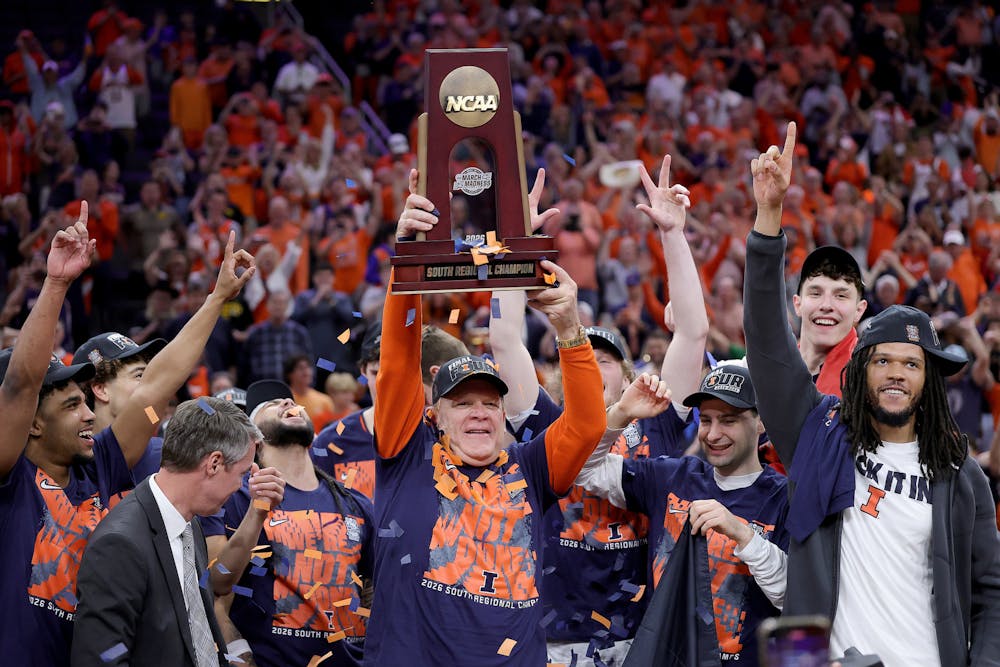
INDIANAPOLIS — Wet seats, damp lockers and moist carpet. Not the ideal state of a basketball locker room, but these were all words to describe Illinois’ reality after each of its two wins to capture the South Region to advance to the 2026 Final Four.
The moisture in the Illini’s locker room wasn’t because of the humidity in Houston, the site where Illinois was playing, and it wasn’t due to any sort of spill or accident — the water all over the room was deliberate.
Deliberate, with water guns, and Brad Underwood was the first to fire.
Instead of discussing with his team about Illinois’ wins in the Sweet 16 or Elite Eight, Underwood decided that a water gun fight would be the best way to engage with his team in the locker room.
“We're going to have some sort of celebration after a win…I want us to have fun,” Underwood said of his team’s unique way to respond to advancing to the biggest stage in college basketball.
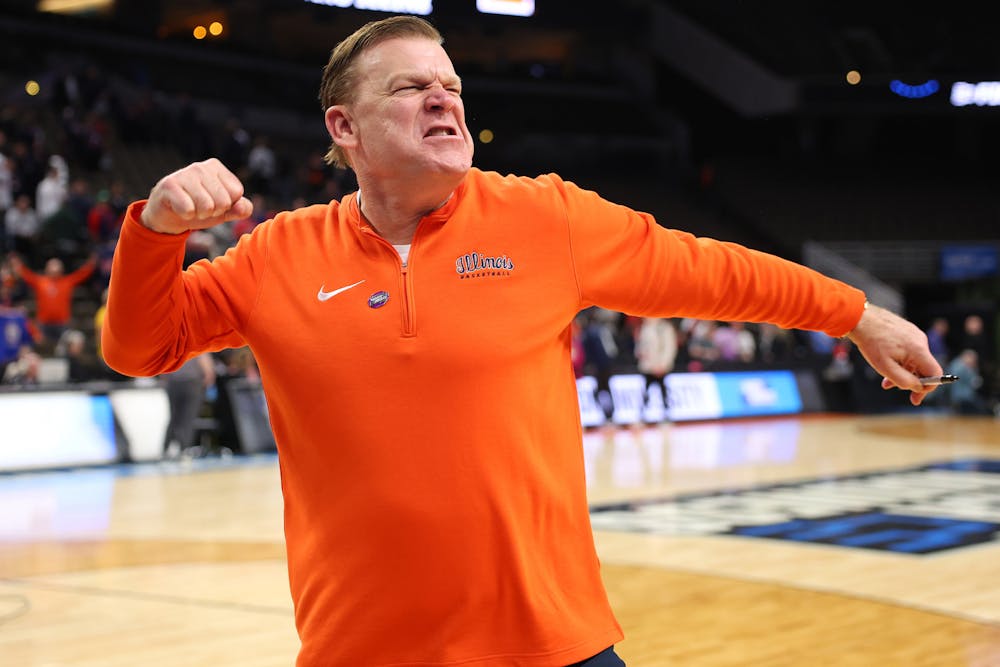
His team’s celebration was different because he’s different — and he’s taken an unorthodox approach to reaching the Final Four in 2026. Not just with the way he celebrates with his team, but in how his roster was assembled and the path that Underwood took to get there.
Water guns symbolize the spirit of Underwood’s Illinois basketball, and they’re a microcosm of the abnormality that got the Illini to get to the Final Four for the first time in 21 years – and for its head coach, the first time ever.
The McPherson, Kansas native went got his start as the head coach at Dodge City Community College to an assistant at Western Illinois, going back to the JUCO ranks with Daytona Beach Community College after that. He also had to be an assistant at Kansas State, and then at South Carolina, all before Underwood finally landed a head job at the Division I level.
Stephen F. Austin was the first to give Underwood a shot, but even though he broke the record for most wins by a Division I head coach in his first three seasons on the job, Underwood was forced to wait another year before a high-major job came calling.
And after a season in Stillwater, Underwood’s “dream job” opened up, an opportunity to coach the Illinois Fighting Illini. Not a blue blood by any means, but for Underwood, Champaign was exactly where he wanted to be.
Again, unusual. But, again, unusual is exactly who Underwood is.
“He's a little crazy,” Tomislav Ivisic said. And Ivisic, just based on the fact that he’s on Illinois’ roster, proves so.
Underwood may not have been the first coach to recruit European players to his program, but he’s certainly become known for it. From posing in a Balkan tracksuit and hat before the season, to advocating for European players whenever he’s asked about it, Underwood has embraced his reputation for going overseas to score top talent.
“I've always loved them,” Underwood explained. But this iteration of his team is built with even more of a European flair.
Among each of the 365 Division I basketball teams in the country’s top six scorers, Illinois has the largest number that is European, with four. The Illini have leaned into their international nature, and constructed a team from a few different countries in southeast Europe.
Tomislav and Zvonimir Ivisic are from Croatia, while Andrej Stojakovic is Greek and David Mirkovic is Montenegrin. These four make up what has been dubbed the “Balkan Bloc,” as there’s nothing normal about the way Illinois constructed.
Because few things about Underwood’s program are. Although, it’s to the benefit of the Illini.
Underwood’s personality, one that may be intimidating to some, actually makes his European players more comfortable.
“He reminds me a lot of our coaches from back home,” Tommy Ivisic said. “I just feel like that's what we're used to as kids. We have a lot of coaches that care a lot, that yell, that scream. It's just something, for me, where I feel comfortable.”
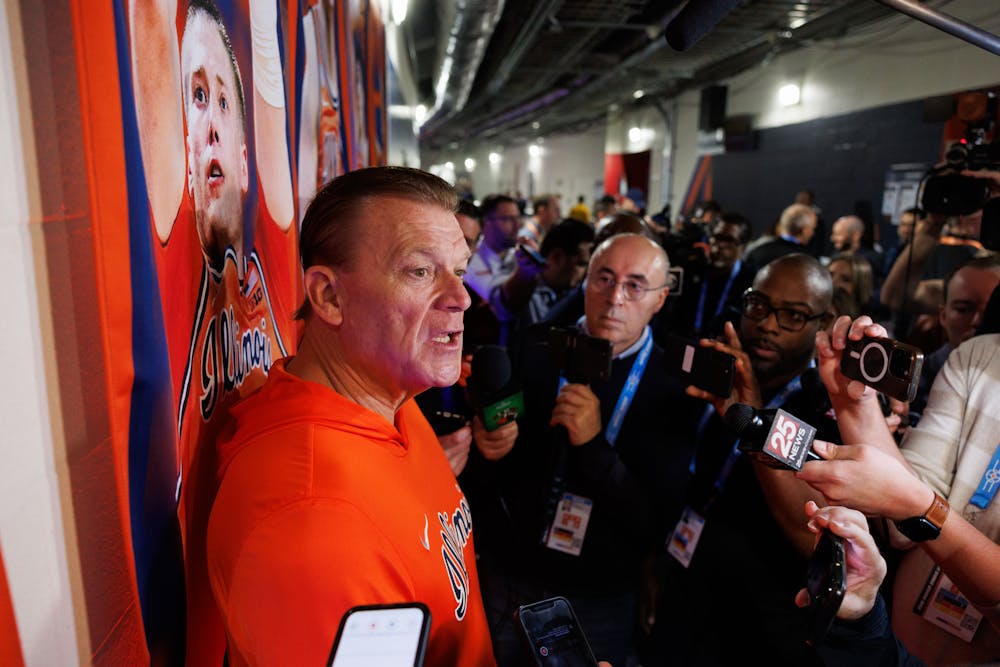
The style of coaching Underwood employs has played a small, yet important role in Illinois becoming an extremely connected team, on and off the floor. With the European players comfortable with each other, and with the rest of the group, the culture inside Illinois’ program has been able to thrive — which has helped the Illini win more ballgames.
Underwood has a 193-109 record in his tenure at Illinois, with one Big Ten regular season title and one Big Ten Tournament crown. But none of that trumps the accomplishment of getting to a Final Four, something Underwood has been in eternal search for.
“How close we are off the court is I think really what separates us apart. We all live in the same building. We see each other constantly. The amount of time we spend in the gym, even when we're not playing basketball, in the lounge, in the team room, eating breakfast every single day with each other, cracking jokes, it's ultimately what translates our chemistry on the court. I think that's what's so special about this group,” Stojakovic mentioned after their Elite Eight victory over Iowa.
The bond between the European and American players, including Kylan Boswell and Keaton Wagler, is incredibly strong as well. Boswell, who is a native of Champaign, outlined that the offseason was the difference in Illinois becoming so close.
Both in the gym and outside the gym, Boswell mentioned that the time spent together bred a togetherness that is visible on the court to this day.
“All of that was developed in the offseason. Being around each other every day in the summer. There's really not that much to do other than go play basketball and chill,” Boswell said. “Just all the connections and all the love. It's always built throughout the offseason.”
Tommy Ivisic mentioned that he went to the Indianapolis 500 this year with Jake Davis. Davis mentioned that he has his teammates over at his house in Indy frequently. These players don’t just play together on the court — they live it out almost every single day.
And everything stems back to Underwood. He was the one who decided to go further outside the box and recruit more Europeans, but the right Europeans that would build team chemistry.
“He's done a great job putting a group of guys together,” Boswell said of his coach.
He was the one whose fiery personality at times has made his players more comfortable, and he’s the one that facilitates a culture of togetherness — one that allows for water gun fights after the biggest game of the season up to that point.
But now there’s a new biggest game of the season, a Final Four matchup with UConn inside Lucas Oil Stadium in Indianapolis. It’s been a long, winding road to get to where he’s at today, but Underwood finally has a Final Four appearance next to his name — and he’ll continue to do everything his way.
“Then it ultimately comes down to you've got to be very solid in your base, in your foundation and what you do,” Underwood explained.
For him, Underwood’s foundation might seem a bit unorthodox, but that’s according to his path. It was a winding road to get where he is today, but Underwood is just two wins away from a national title with a roster that fits his unconventional style.
And if he does win it all, it would be, well, different. For him, and for the university that has waited over a century for it.
Different, just like the way Underwood constructs his roster. Just like the way he goes about his coaching. And just like those water guns.