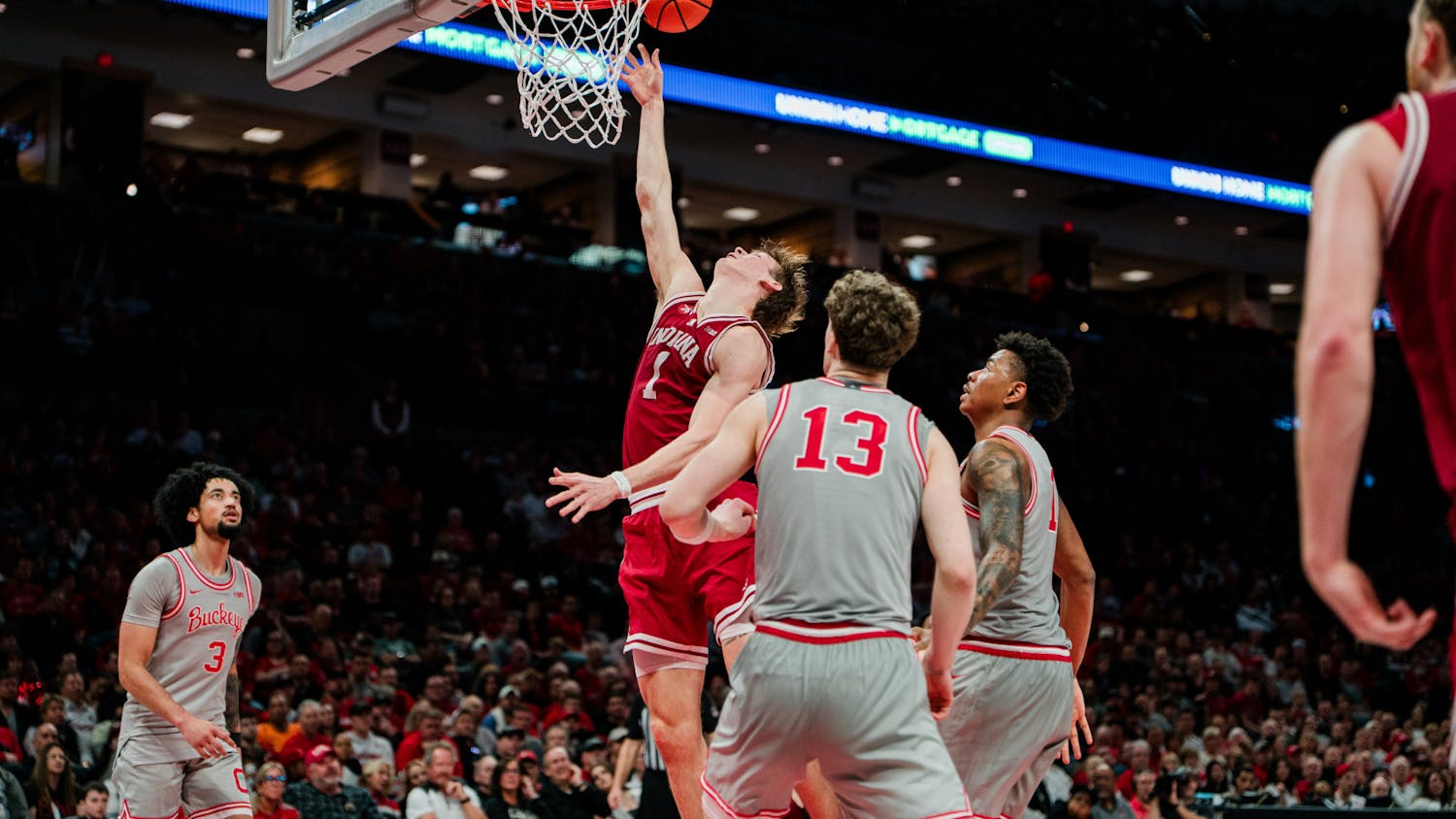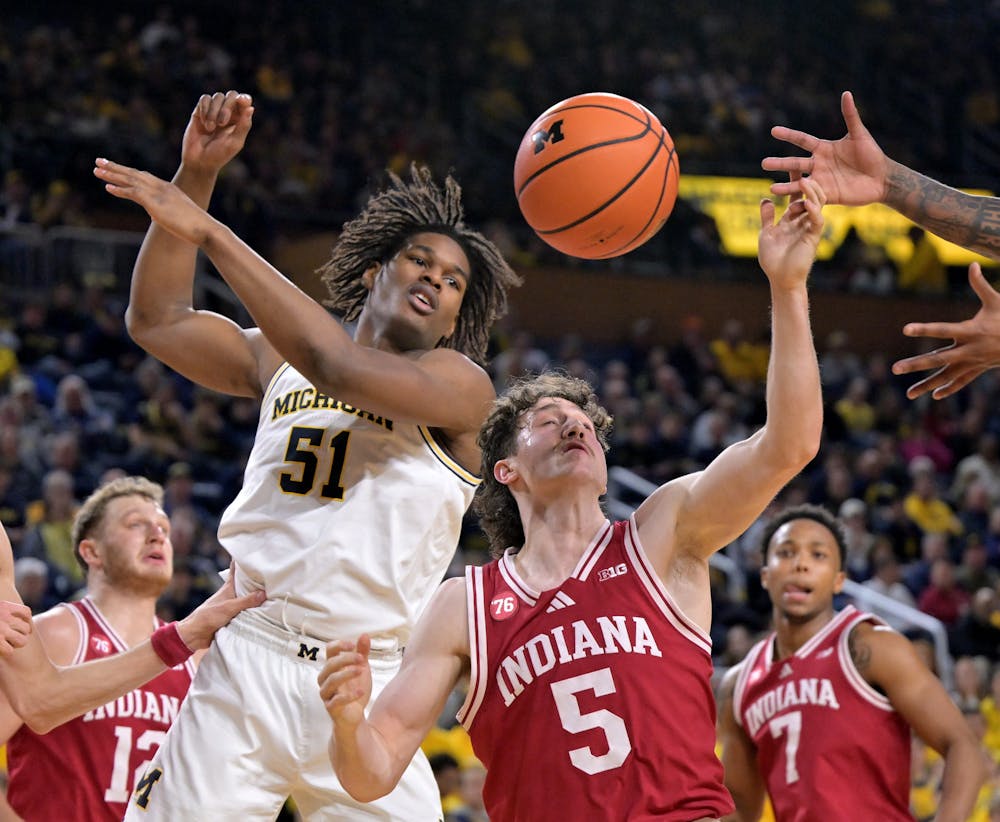
With a head coach in his first year and a roster that features zero returning players from last season, Indiana men’s basketball understandably has multiple observable flaws. Its imperfections are justified considering the circumstances surrounding this season, but they stand out in box scores and to the naked eye game after game, particularly in losses. Chief among these imperfections is Indiana’s apparent lack of interior size.
At the outset of the season, it became clear that much of Indiana’s offensive success would come from perimeter shooting. The Hoosiers are inside the top three in the Big Ten in 3-point attempts and 3-point makes, and astonishingly, just 41.2% of their points come from field goals inside the arc — 342 Division 1 teams are above that mark.
It’s safe to say that Indiana’s offense is fueled by its 3-point shooting. Much of that, of course, is derived from the fact that one of the roster’s strong suits is outside shooting. Another prominent factor, though, is one of the team’s leading flaws, its lack of interior size.
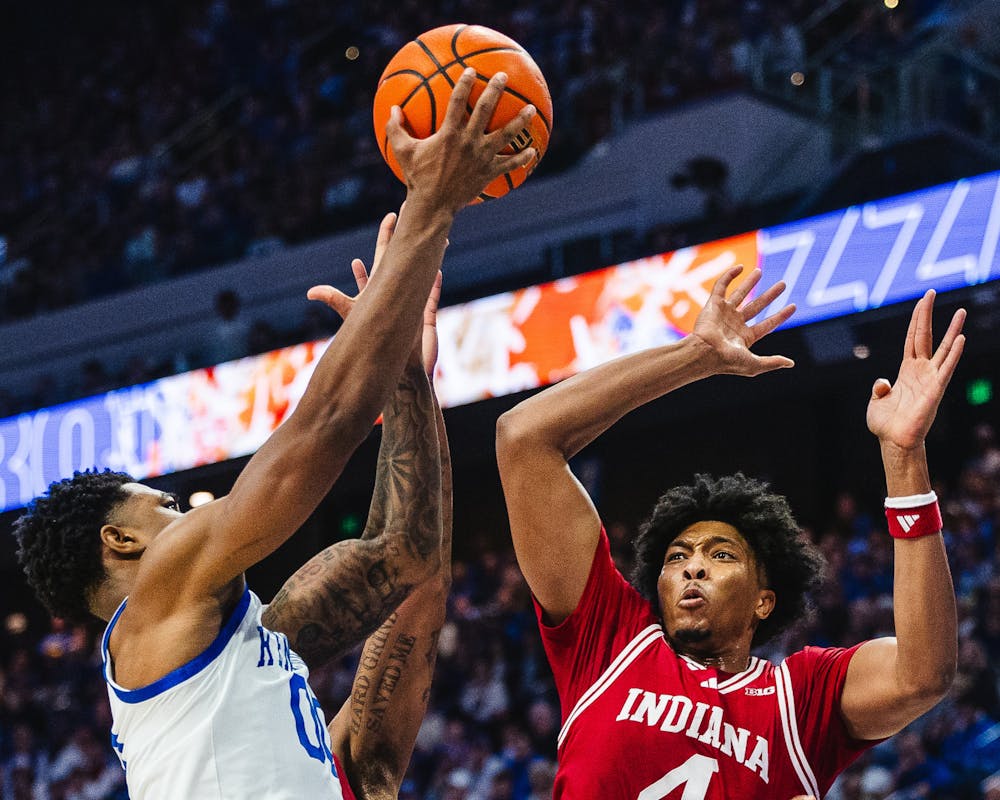
The gaping hole that obstructs Indiana’s path to achieving its offensive and defensive goals exists in the frontcourt. There are 13 Big Ten teams with more offensive rebounds in conference games than the Hoosiers, and 16 with more blocks. Especially against elite competition, it doesn't take long to notice Indiana’s disadvantage in the painted area.
In a world full of unpredictable and dynamic offenses, the Hoosiers employ an approach to scoring that is tangibly unstable. It’s no secret that 3-point shooting is dangerous, but erratic. In the modern era of basketball, shooting a high volume of triples is acceptable and respectable. The issue for Indiana is that there is not a reliable frontcourt presence to supplement it.
More often than not, for any team, 3-point attempts are unsuccessful. If an offense is going to find consistent success approaching offense that way, it must also reap the benefits of physical prowess on the glass.
Therein lies the issue for the Hoosiers. Too often, possessions end early on account of a failure to secure an offensive rebound. Additionally, the lack of second-chance points ramps up the pressure on the guards to generate offense from around the perimeter. As soon as 3-point shooting naturally drops off, scoring droughts and inflated deficits frequently follow.
On the defensive end of the floor, the frontcourt is often a liability as well. First and foremost, opponents are able to establish an offensive rhythm by feeding the ball through the post. Even worse, with a size disadvantage, it’s incredibly difficult to defend the beasts of the Big Ten down low. As a result, Indiana struggles to defend without fouling, and has racked up the most personal fouls of any team in the Big Ten.
Inadequate supplementation of outside shooting on offense and insufficient frontcourt fortification on defense is a recipe for limited success in a conference like the Big Ten. Indiana certainly exemplified that idea so far this season, especially on the road and against the best of the league and nation at large.
A game that perfectly fits both of those categories was Tuesday’s 86-72 loss to No. 3 Michigan in Ann Arbor. The Wolverines are among the best in the Big Ten at utilizing their size and athleticism, evidenced by the fact that they recorded 16 more rebounds and 10 more points in the paint against the Hoosiers, a noticeable difference.
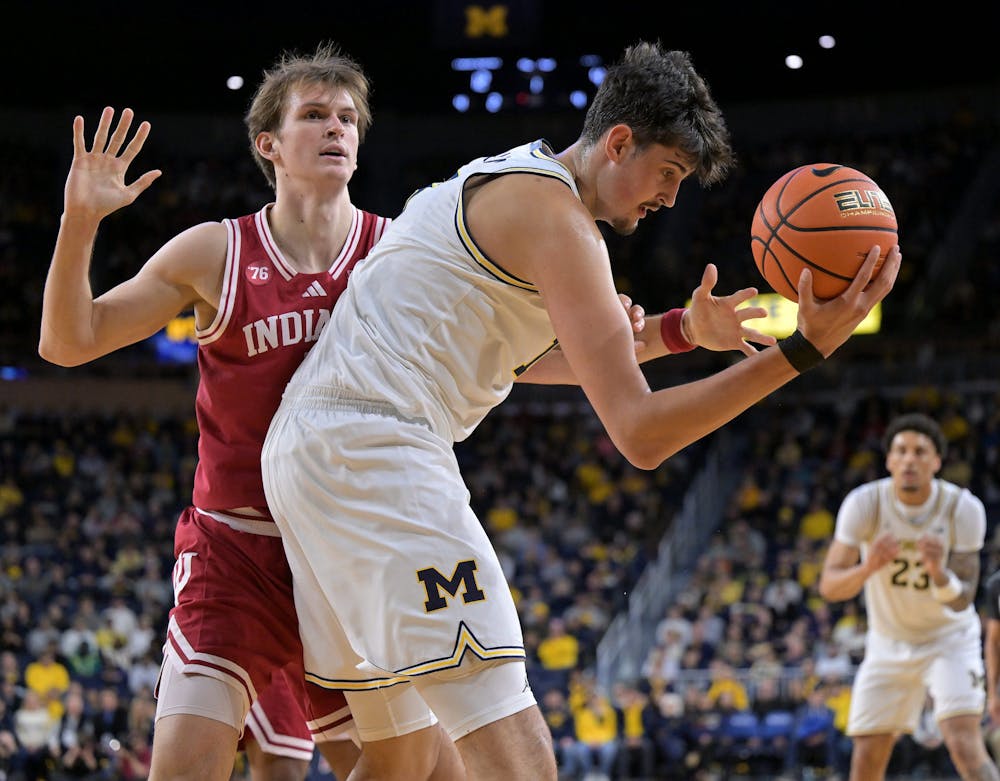
Indiana couldn’t sustain quality shooting during the road trip, opening the game in Ann Arbor missing 14 of its first 15 field goal attempts. Perimeter shooters were blanketed, but more importantly, they didn’t have an authoritative presence in the frontcourt to fall back on. Michigan owned the blocks, and amassed a 25-point lead, essentially ending the game before it could truly begin.
The Wolverines aren’t the only team that has exploited this weakness. No. 12 Michigan State, two games prior, beat the Hoosiers by 21 with 18 more rebounds and 10 more points in the paint.
What’s worse, is that four of the top five teams in the Big Ten standings have at least one player over seven feet tall, and Indiana has none. It’s likely that this deficiency will consistently be exposed week after week.
In the Big Ten in 2026, size and athleticism in the frontcourt is a requirement for legitimate involvement in the championship race. If Indiana is rendered irrelevant to the conference championship race in the waning weeks of the season, it may not necessarily be because it shoots a high volume of 3s, but rather because it does not have the reliable frontcourt presence to supplement it.
Across the board, there are a variety of reasons for and causes of Indiana’s four-game losing streak. A lack of interior size is perhaps the most prominent and permanent of them all, and may solidify the ceiling of Indiana’s success as the Big Ten season presses onward.