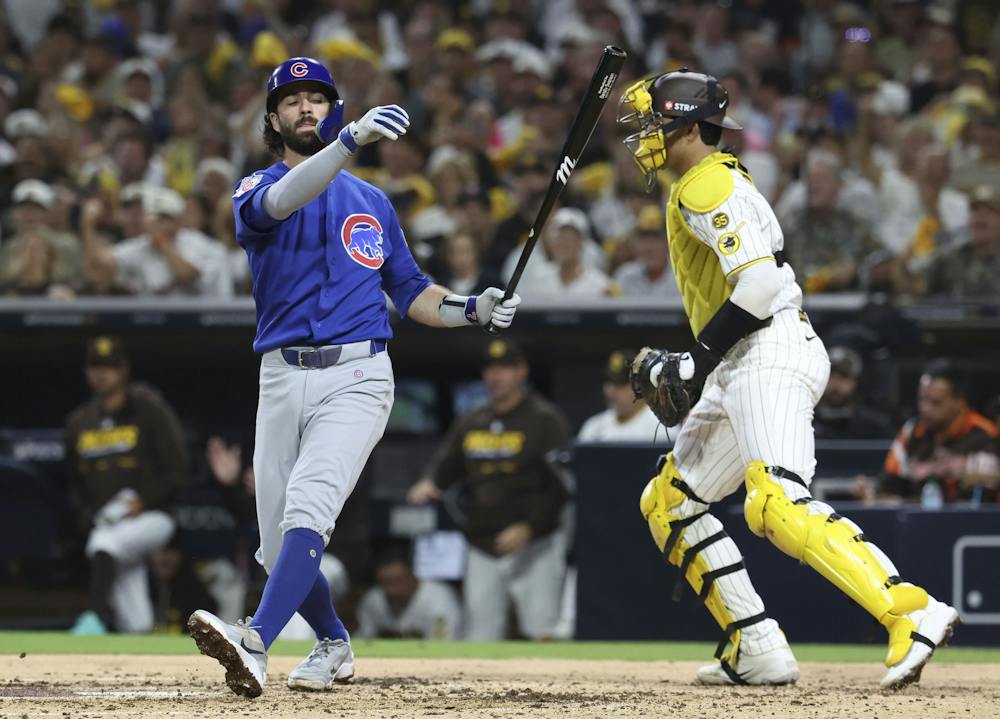
After six months of streaks, injuries, home runs and pitching changes, the Chicago Cubs’ 2026 season ended in just two nights in San Diego.
The Cubs finished the regular season 89-73, reaching the postseason for the second consecutive year. Yet when the games mattered the most, the offense disappeared, and the pitching could not provide what was needed to carry this team further. Chicago lost 8-0 and 4-1 to the Padres in the Wild Card series.
Those two games did more than eliminate the team for the season. They provided answers to the two questions that have been asked throughout the season: Could the pitching staff hold up? Could the offense remain consistent?
For 162 games, the answer was more often than not yes. For the final two, it was no.
Chicago became the fifth team in MLB history to produce two separate winning streaks of at least 10 games. Then came a 10-game losing streak. By June 10, the Cubs had fallen to .500. They recovered later in June, of the season but this only reinforced the pattern of their season. When they were hot, they seemed unstoppable but when they weren't, they fell apart just as quickly.
The Cubs finished first in MLB in runs with 850 and walks with 674, while posting a .428 slugging percentage and a .767 OPS. They also led the National League with 220 home runs. August showed just how hot the team could get, as the Cubs hit a franchise-record 62 home runs during the month. Pete Crow Armstrong also made history, joining the 40-40 club and finishing tied for the National League league with 45 home runs.
However, the pitching staff had a much more difficult path. Cade Horton suffered a season-ending elbow injury in April, beginning a sting of injury problems for the team. Justin Steele, Edward Cabrera, Matthew Boyd and Ben Brown all dealt with injuries this season.
Chicago acquired David Peterson, Kevin Gausman and Clay Holmes before the trade deadline, greatly improving the rotation’s overall ERA. Pitchers like Boyd and Shota Imanaga began turning their seasons around as well. The starters finished the regular season with an overall 4.27 ERA, 18th in MLB.
The Cubs’ postseason started poorly from the first inning. Boyd delivered a changeup to Fernando Tatis Jr., who sent the ball 405 feet to center field. Only two batters later, Manny Machado hit another changeup over the wall. Suddenly, the Cubs were down 2-0 before the third out was even recorded. Later in the game, Xander Bogaerts added another home run off Boyd’s changeup. After Javier Assad entered the game, the Cubs still couldn’t stop the Padres as they fell 8-0.
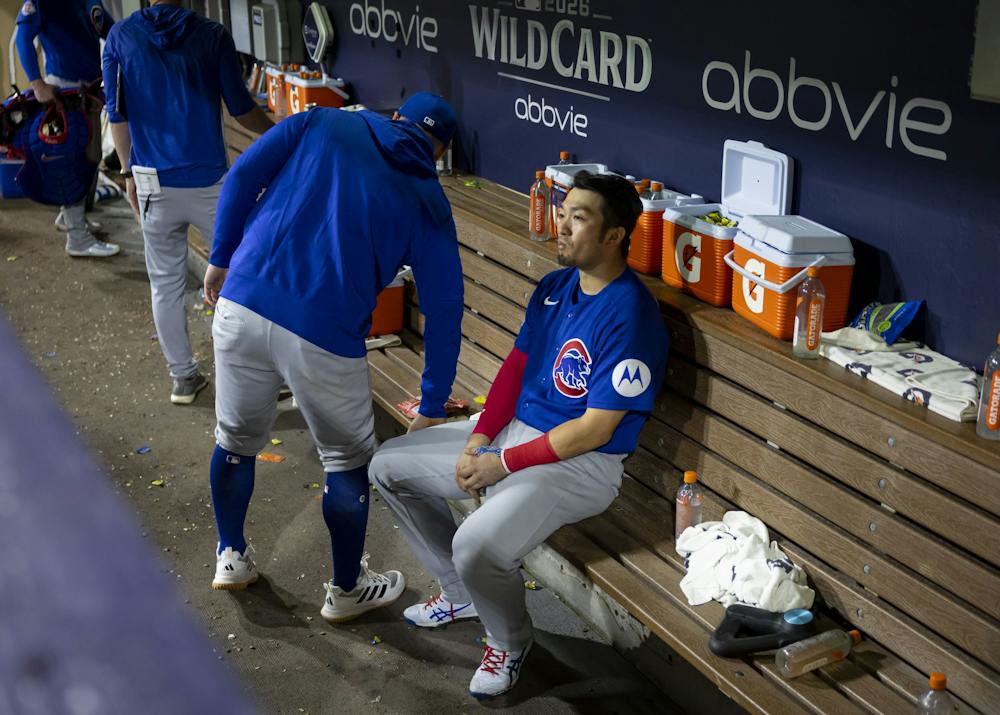
Padres starter Michael King did the exact opposite. He carried a no-hitter into the seventh inning before Nico Hoerner broke it up with an infield single. The Cubs couldn’t prevent runs or score them.
Game 2, although not great, looked more like postseason baseball. Gausman took the mound and allowed two runs in the second inning. The Cubs responded in the fourth when Hoerner drove in the first — and last — run of the postseason for Chicago. The team fell 4-1.
Across the Wild Card Series, Chicago hit .129, going 8-for-62. Two players at the center of the Cubs’ regular-season success, Alex Bregman and Crow-Armstrong, combined to go 0-for-15 with eight strikeouts.
The team that led Major League Baseball in runs scored one run in 18 postseason innings.
It would be easy to look at the 12 runs allowed and say pitching was the only reason for the defeat, but that’s just not true. No pitching staff can be expected to win a series when its offense scores only one run in the entire series.
During the regular season, the offense could usually cover for an inconsistent pitching night, while other times a strong starting performance compensated for a quieter offensive performance. Over 162 games, the strengths and weaknesses balanced each other out. But the best-of-three series didn’t allow for that, and the team learned it quickly in just 18 innings of baseball.
Assuming the 2027 MLB season occurs, the Cubs shouldn’t treat this roster as one that needs a rebuild. An 89-win team that reached consecutive postseasons has a strong foundation. But reinforcements need to be made.
First, the team needs more stability at the top of the rotation. The Cubs can’t spend another summer wondering who is making the next start because of injuries. Injuries are unavoidable, of course, but adding a durable starter would give the Cubs extra protection and a pitcher capable of taking on a postseason start.
Second, they need a more defined late-inning bullpen. Chicago entered the postseason without a set closer after plenty of inconsistency throughout the season. A dependable reliever would give the Cubs clearer options to close out games.
Finally, the Cubs need to figure out why the highest-scoring offense disappeared in October. That doesn’t mean changing the core of the lineup. The contrast between 850 regular-season runs and one postseason run is too drastic to ignore. Against elite pitching, Chicago needs a way to manufacture offense when the home runs stop.
Above all, the key factor the Chicago Cubs need is consistency. That was missing during the 2026 season. Two 10-game winning streaks were followed by a 10-game losing streak. The Cubs fell to 34-34 before recovering to win 89 games. The rotation was decimated by injuries before becoming one of baseball’s strongest, while an offense that led MLB in runs managed to score only once in the playoffs.
The Cubs spent 162 games proving how good they could be. The Padres needed only two to prove how quickly that could disappear.


