
With 35 wins in 47 games, Indiana has accomplished more than enough to deserve a seat at the same table as the top contenders in the Big Ten and beyond.
The 35 wins most definitely headline the evidence for the legitimacy of the Hoosiers, but what separates Indiana from the pack of quality Big Ten teams and plants the Hoosiers in the range of quality Big Ten teams that can actually make noise beyond conference competition is the scale of many of their wins.
Indiana wins far more than it loses, as many quality teams do, but the point of separation exists in the realization that Indiana wraps up its wins early far more frequently than many of its fellow contenders. In fact, the 14-1 win in five innings over Valparaiso on Wednesday marks Indiana’s 19th run-rule win this season, which significantly outnumbers the team's 12 total losses.
Unsurprisingly, Indiana head coach Shonda Stanton is appreciative of those triumphant results.
“That means you’re taking care of business and doing what you’re capable of doing,” Stanton said after the win over Valparaiso on Wednesday.
Stanton’s Hoosiers win by run rule more than they lose by any score. Additionally, Indiana’s 19 run-rule wins outweigh its 16 wins in contests that last the full seven innings. What elevates the impact of those facts is the understanding that Indiana achieves its run-rule victories with balanced, well-rounded success.
In its 19 run-rule wins this season, whether they require five innings or six, Indiana has scored an average of 11.1 runs while its opponents have scored an average of 1.1 runs. If a team leads by a minimum of eight runs after five innings or more, the game ends early. On average, Indiana wins by 10 runs when it disposes of its opponents in short order.
To win by 10 runs in games that last fewer than seven innings, and do so commonly, a team must benefit from the output of a potent offense and the fortifications of a resolute defense.
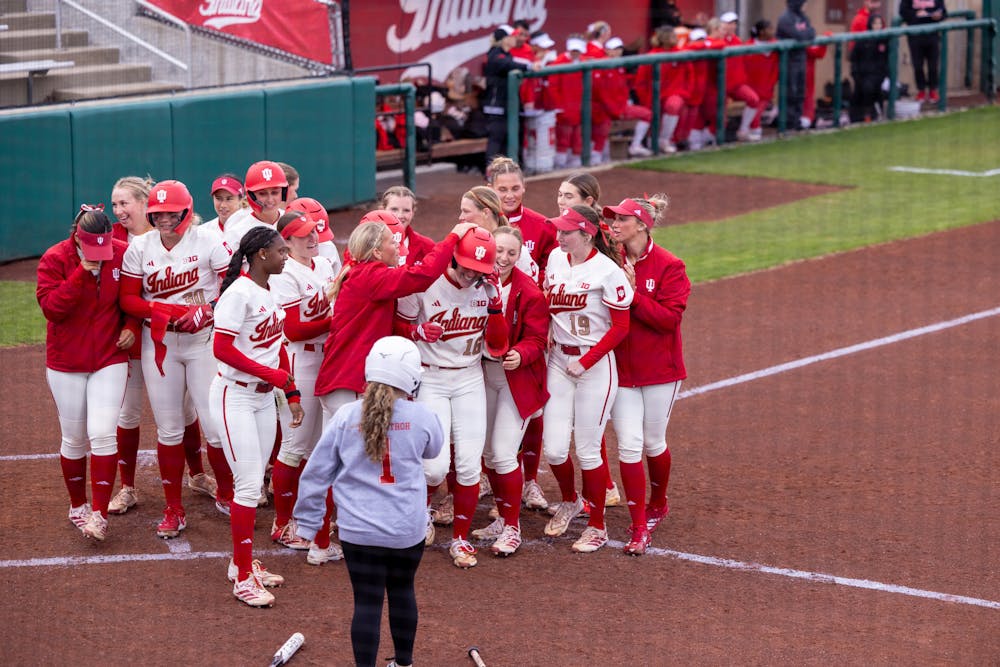
Indiana checked both of those boxes on Wednesday, hitting four home runs and pitching four consecutive scoreless innings against Valparaiso.
After the game, Indiana shortstop Alex Cooper spoke on what she observes when her team wraps up wins in advance of the seventh inning.
“I think it just shows how powerful not only our offense is, but how powerful our pitching staff is on the other side holding the team to that many runs,” Cooper said.
The Hoosiers do more than just win, they win big. They do more than just win big, too, by winning with a complete effort put forth by every section of the roster.
Those triumphs don’t just come against inferior opponents, either. Valparaiso may be a struggling Missouri Valley Conference team with more losses than wins this season, but Indiana has run-rule wins over more formidable competition as well.
In February, Indiana beat Ohio State 12-3 in five innings in a non-conference contest. Ohio State was ranked No. 25 in the country at the time and currently holds a winning record within the Big Ten. Also in February, the Hoosiers beat South Florida 11-1 in five innings. South Florida now has over 30 wins and appears to be poised to return to the NCAA Tournament.
Additionally, Indiana has achieved a run-rule victory in three of its six conference series so far this season. The Hoosiers beat Rutgers 12-2, Maryland 10-2 and Purdue 9-0, requiring only five innings to do so in each contest.
A run-rule win, especially against a conference opponent, looks fantastic on a resume. It almost certainly feels fantastic to the team, too, as the Hoosiers continuously reinforce their confidence in their own abilities.
Beyond that, a win in fewer than seven innings directly influences the team’s likelihood of future success. In the circle, less is asked of Indiana’s pitchers when so many innings are waived due to incontrovertible leads. The pitching staff preserves its longevity for future endeavors as a result.
Certain evaluation metrics, which are relevant to the process of the NCAA Tournament selection committee, consider run-rule victories meaningful.
After racing past Valparaiso, Stanton spoke on the role of margin of victory in the postseason selection process.
Stanton referred to RPI as “outdated,” in part because many of the factors that contribute to its evaluations are out of a given team’s control. DSR and KPI, in contrast, focus more on a specific team’s actual accomplishments, such as margin of victory.
“It also helps in factors like the DSR or the KPI…” Stanton said. “It takes into account some of those other variables and so run rules do matter in those situations.”
Indiana wins in short order and renders a seventh inning unnecessary quite often. Those results are especially worthy of note as the Hoosiers barrel towards the postseason with continually compounding momentum.
The 14-1 win over Valparaiso only adds to that momentum, while reinforcing both the team’s confidence and the reality that Indiana is deserving of a seat at almost every successful table in college softball.